


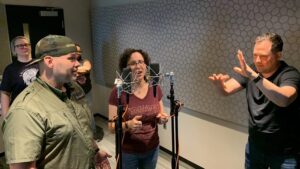
 What is a loop group?
A loop group is a team of voice actors who record the background voices you hear in movies, TV shows, video games and animation. Think of the murmur in a busy restaurant, the shouts at a ballgame, or a cop yelling “Clear!” off-screen. Those sounds rarely come from the day of filming. A loop group adds them later, in a recording studio, during post-production.
If you’ve ever wondered why a crowd scene sounds so full and natural, the answer is usually a loop group. In this post, we’ll cover what a loop group is, where the name comes from, what loop group actors do, and why nearly every production relies on them.
Where the name “loop group” comes from
The term dates back to the days of physical film. To re-record dialogue, editors cut a scene into a strip of film and spliced the ends together into a loop. The loop played over and over while actors watched it and matched their lines to the picture. This process became known as “looping.”
Today the same work is called ADR, short for automated dialogue replacement, and it happens digitally. But the old name stuck. A group of actors who “loop” background voices is still called a loop group. You may also hear them called an ADR group or a walla group.
What does a loop group actually do?
Loop group actors fill in every voice that isn’t a main character’s scripted dialogue. Their work usually falls into a few categories:
- Walla. This is general crowd chatter where no single word stands out. The name traces back to old radio, where actors reportedly muttered “walla walla” to sound like a crowd. Modern loop groups improvise real, scene-appropriate conversation instead.
- Specific lines. These are short, clear lines from background characters, like a waiter announcing a table, a nurse paging a doctor, or a soldier calling out orders.
- Callouts and reactions. Gasps, cheers, boos, laughter and screams that sell a big moment.
- Efforts. Grunts, breaths and exertion sounds for fights, falls and stunts.
- Specialized voices. Accents, foreign languages, period-accurate slang, or technical jargon for medical, military and police scenes.
Good loop group work is invisible. You only notice it when it’s missing, because a scene without it feels strangely empty.
How a loop group session works
Loop group sessions take place after the picture is edited, typically on an ADR stage. A loop group coordinator casts the actors and runs the session alongside the sound team. A typical session looks like this:
- Prep. The coordinator reviews the cut, notes every scene that needs background voices, and researches the setting, era and any specialized terminology.
- Casting. The coordinator books a mix of voices (ages, genders, accents and languages) that fits the world of the show.
- Watching the scene. Actors gather around microphones and watch the clip on screen to understand the mood, location and action.
- Recording. The group performs the scene several times, often in smaller clusters, so the mixer has layers to build a crowd of any size.
- Mixing. The sound team blends the recordings under the main dialogue so the background feels real without distracting from the story.
A small group of skilled actors can sound like a stadium. Clever layering means a handful of voices can stand in for hundreds of people.
Why productions use loop groups instead of on-set audio
It might seem easier to record crowd noise during filming. In practice, that rarely works. Here’s why:
- Clean dialogue comes first. On set, background extras usually mime their conversations silently. That keeps the main actors’ lines clean and easy to edit.
- Control in the edit. When background voices are recorded separately, the sound team can raise, lower or swap them shot by shot.
- Accuracy. A loop group can add the right accents, languages and jargon, which extras on set may not provide.
- Story support. Directors use background lines to plant information, add humor, or build tension without stopping the scene.
- Animation and games. In animated films and video games, nothing is recorded “on set,” so loop groups create every background voice from scratch.
What it takes to be a loop group actor
Loop group work is a specialty within voice acting, and it rewards a particular set of skills:
- Fast improvisation. Most walla isn’t scripted, so actors invent believable, scene-specific conversation on the spot.
- Research. The best loop actors know the vocabulary of hospitals, courtrooms, kitchens and battlefields.
- Range. Being able to shift age, accent, energy and language makes an actor far more useful in a session.
- Restraint. Background voices must sit under the scene, never steal it. Knowing when to stay quiet matters as much as speaking.
- Teamwork. Loop actors often perform in small groups and have to listen and react to each other in real time.
Most loop group actors get work through coordinators and ADR studios rather than open auditions. Many start with improv or voice acting training and build relationships within the post-production community.
Loop group FAQ
Is a loop group the same as ADR?
Not exactly. ADR is the overall process of recording dialogue in post-production, including re-recording lines from the lead actors. A loop group is one part of ADR that focuses on background and supporting voices.
What is walla?
Walla is the general murmur of a crowd, recorded so that no individual words stand out. It’s one of the main things a loop group records.
Do loop group actors get credited?
Often, yes. Many films and shows list loop group actors in the end credits, sometimes under headings like “Loop Group” or “ADR Voices.”
Are loop group actors union performers?
On many professional productions in the U.S., loop group work falls under SAG-AFTRA agreements. Rules vary by production and project type.
Do video games use loop groups?
Yes. Games need large amounts of background chatter, crowd reactions and combat callouts, and loop groups record much of it.
The bottom line
So, what is a loop group? It’s the team of voice actors who give movies, shows and games their sense of life. They record the crowds, the background conversations, and the small lines that make a world feel lived in. The name comes from the old practice of looping film, but the job is as essential as ever.
Next time you watch a busy scene, close your eyes and listen. Much of what you hear was likely created by a loop group, long after the cameras stopped rolling.